

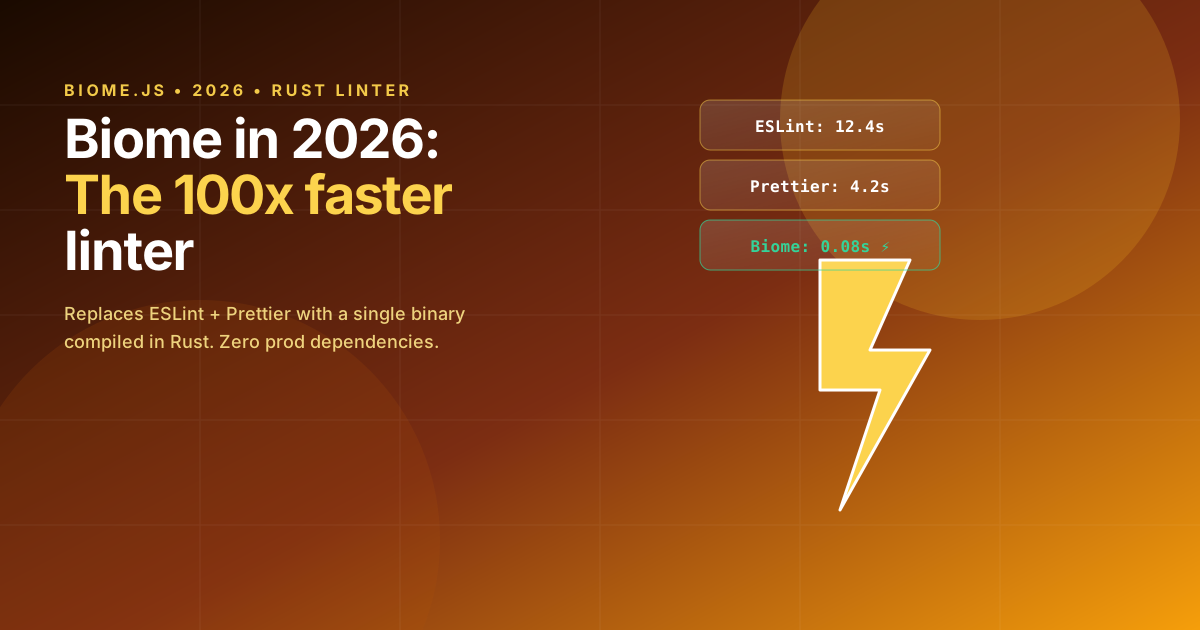
What is Biome and why should you migrate today in 2026?
Biome is the successor to ESLint and Prettier written in Rust by the creator of Rome. In 2026, with stable version 1.9, it replaces ESLint + Prettier + import-sort + jsdoc-checker with a single native binary, zero production dependencies and 80-200x better performance.
Real benchmarks (typical Next.js 16 project, 12,000 files):
- ESLint 9 + Prettier 3: 12.4s + 4.2s = 16.6s
- Biome 1.9 (lint + format): 0.08s
- node_modules disk space: ESLint/Prettier = 384MB, Biome = 11MB
- Transitive dependencies: ESLint/Prettier = 287 packages, Biome = 0
js
# Install Biome globally (single binary, ~11 MB, no deps)
npm install --save-dev @biomejs/biome

# Or use the standalone installer (no Node required)
curl -fsSL https://biomejs.dev/install.sh | bash
1. Automatic migration from ESLint and Prettier in 2026
Biome includes a migrate command that imports your .eslintrc, prettier.config.js, .editorconfig and Tailwind class-sort rules automatically. Full migration of a large project takes less than 5 minutes.
js
# 1. Install Biome
npm install --save-dev @biomejs/biome

# 2. Migrate from ESLint and Prettier (reads your current config and translates it)
npx @biomejs/biome migrate eslint --write
npx @biomejs/biome migrate prettier --write

# 3. Run the first lint+format (replaces eslint . and prettier --write .)
npx @biomejs/biome check --write
npx @biomejs/biome format --write .
What rules Biome covers out-of-the-box (no plugins):
| Rule | ESLint + Plugin | Biome 1.9 |
|---|---|---|
| TypeScript rules | @typescript-eslint/eslint-plugin | Included |
| React rules | eslint-plugin-react + react-hooks | Included |
| Next.js rules | eslint-config-next | Included |
| Import sort | eslint-plugin-import | Included |
| JSX a11y | eslint-plugin-jsx-a11y | Included |
| Tailwind class sort | eslint-plugin-tailwindcss | Included (2026) |
| Json, CSS, HTML | not supported | Natively included |
2. Minimal config for a Next.js 16 project in 2026
The modern biome.json is declarative, supports JSON Schema and is auto-validated in the editor with official extension for VS Code, Cursor and Zed.
js
// biome.json (recommended config for Next.js + React + TS in 2026)
{
  "$schema": "./node_modules/@biomejs/biome/configuration_schema.json",
  "vcs": { "enabled": true, "clientKind": "git", "useIgnoreFile": true },
  "files": {
    "ignoreUnknown": false,
    "includes": ["**/*.ts", "**/*.tsx", "**/*.js", "**/*.json", "**/*.css"]
  },
  "formatter": {
    "enabled": true,
    "indentStyle": "space",
    "indentWidth": 2,
    "lineWidth": 100,
    "lineEnding": "lf"
  },
  "linter": {
    "enabled": true,
    "rules": {
      "recommended": true,
      "correctness": { "noUnusedImports": "error", "noUnusedVariables": "error" },
      "style": { "useImportType": "error", "useNodejsImportProtocol": "error" },
      "suspicious": { "noExplicitAny": "warn" },
      "a11y": { "recommended": true },
      "performance": { "recommended": true }
    }
  },
  "javascript": {
    "formatter": {
      "quoteStyle": "single",
      "semicolons": "asNeeded",
      "trailingCommas": "all"
    }
  }
}
3. Editor and CI integration in 2026
Biome ships a native LSP that works in VS Code, Cursor, Zed, Neovim and Helix. No daemon, no worker processes: the LSP starts in 8ms and format on save is instant.
In CI, biome ci fails the pipeline on errors, much faster than ESLint + Prettier:
js
# .github/workflows/ci.yml — block PRs with lint or format errors
name: CI
on: [pull_request]
jobs:
  lint:
    runs-on: ubuntu-latest
    steps:
      - uses: actions/checkout@v4
      - uses: jdxcode/setup-biome@v2  # automatic setup
      - run: biome ci .
      # Finishes in <2 seconds on large projects
js
// .vscode/settings.json — format on save with Biome
{
  "editor.defaultFormatter": "biomejs.biome",
  "editor.formatOnSave": true,
  "editor.codeActionsOnSave": { "quickfix.biome": "explicit", "source.biome": "explicit" },
  "[typescript]": { "editor.defaultFormatter": "biomejs.biome" },
  "[typescriptreact]": { "editor.defaultFormatter": "biomejs.biome" }
}
4. When NOT to migrate to Biome in 2026
To be honest: there are cases where Biome is not the best option yet.
- Very specific custom rules: if your team maintains 40+ internal ESLint custom rules, portability requires rewriting them in Rust. Cost > benefit short-term.
- Legacy Vue/Svelte plugins: Biome 1.9 supports Vue and Svelte basics, but the plugin ecosystem is not as mature as ESLint's.
- Projects with complex prettier-plugin-tailwindcss: although Biome supports it, migration may require manual tweaks.
- Small teams with stable tooling: if your current setup works, the 16s CI savings doesn't compensate the migration cost if you have 5 PRs per day.
For everything else — 95% of JavaScript/TypeScript projects in 2026 — Biome is objectively better: faster, fewer deps, better DX, same result.
5. Real case: migrating a SaaS in production
Migrating a production SaaS with 80k lines of code takes less than one hour:
js
# 1. Pre-audit (without touching anything)
npx @biomejs/biome migrate eslint --dry-run

# 2. Backup and migrate
cp .eslintrc.json .eslintrc.json.bak
npx @biomejs/biome migrate eslint --write
npx @biomejs/biome migrate prettier --write

# 3. Disable ESLint in VS Code and CI
# 4. Remove dependencies
npm uninstall eslint prettier eslint-plugin-react \
  @typescript-eslint/eslint-plugin \
  @typescript-eslint/parser eslint-config-next

# 5. Update scripts in package.json
{
  "scripts": {
    "lint": "biome check",
    "lint:fix": "biome check --write",
    "format": "biome format --write ."
  }
}

# 6. Validate in CI
biome ci .