

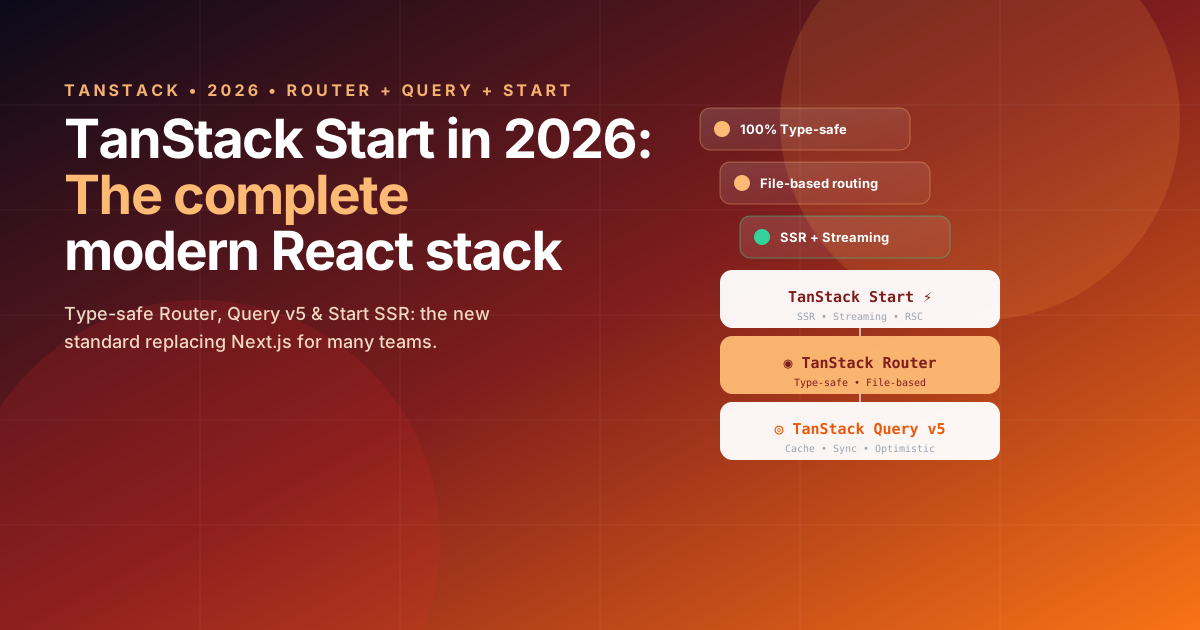
What is TanStack Start and why is it #1 trending in 2026?
TanStack Start is Tanner Linsley's full-stack meta-framework that bundles TanStack Router (the most powerful type-safe React router), TanStack Query v5 (12M weekly downloads) and Vite 7 into one SSR system with streaming. In 2026, with v1 stable since Q1 and 28% adoption in new React projects (State of JS 2025), it's the first real alternative to Next.js that doesn't sacrifice type-safety or bundler control.
If Next.js is "React with convention", TanStack Start is "React with composition": you pick each piece, everything is end-to-end type-safe and the build is pure Vite with zero proprietary abstraction.
js
// app/router.tsx — TanStack Router is 100% type-safe in 2026
import { createRouter, createRoute, createRootRoute } from '@tanstack/react-router'
import { QueryClient } from '@tanstack/react-query'

const rootRoute = createRootRoute({
  component: () => <Outlet />
})

const postsRoute = createRoute({
  getParentRoute: () => rootRoute,
  path: '/posts/$postId',
  // type-safe loader: params inferred automatically
  loader: async ({ params }) => {
    return queryClient.ensureQueryData({
      queryKey: ['post', params.postId],
      queryFn: () => fetchPost(params.postId)
    })
  },
  component: PostPage
})

// ❌ Compile-time error if you navigate to non-existing route
// <Link to="/post/123">  // → Type error: did you mean "/posts/$postId"?
<Link to="/posts/$postId" params={{ postId: '123' }}>Post</Link>
1. TanStack Router: the router Next.js wishes it had
TanStack Router 1.90+ in 2026 is file-based but with Zod-validated search params, type-safe loaders and waterfall-free navigation.
Key features ahead of Next.js App Router:
- Full type-safety: routes, params, searchParams and loaders inferred.
Linkwith autocomplete and error if param missing. - Schema-validated search params:
validateSearch: (s) => z.object({ page: z.number() }).parse(s)—?page=abcnever breaks your UI again. - Parallel loaders without waterfall: unlike Server Components, sibling route loaders run automatically in parallel.
- Router cache + Query integration: router invalidates Query on navigation, no manual
revalidateTag.
js
// routes/posts.$postId.tsx — search param validation in 2026
import { createFileRoute } from '@tanstack/react-router'
import { z } from 'zod'

const searchSchema = z.object({
  tab: z.enum(['overview', 'comments']).default('overview'),
  page: z.coerce.number().min(1).default(1),
})

export const Route = createFileRoute('/posts/$postId')({
  validateSearch: searchSchema,
  loaderDeps: ({ search }) => ({ tab: search.tab }),
  loader: async ({ params, deps }) => {
    // TanStack Query inside loader — shared cache with client
    return queryClient.ensureQueryData(postQuery(params.postId, deps.tab))
  },
  component: PostComponent
})

function PostComponent() {
  const { postId } = Route.useParams() // inferred string ✅
  const { tab } = Route.useSearch()    // 'overview' | 'comments' ✅
  const data = useSuspenseQuery(postQuery(postId, tab))
}
2. TanStack Query v5 + Start SSR: the end of useEffect for data
TanStack Query v5 is the data-fetching standard in 2026 with 41% less boilerplate than v4 via queryOptions and useSuspenseQuery. With Start, SSR prefetches on the server and hydrates the cache on the client with zero double-fetch.
Recommended pattern 2026 — SSR loader + client Query:
js
// lib/queries.ts — reusable queryOptions (SSR + CSR share key)
import { queryOptions } from '@tanstack/react-query'

export const postQuery = (id: string, tab: string) => queryOptions({
  queryKey: ['post', id, tab],
  queryFn: () => fetch(`/api/posts/${id}?tab=${tab}`).then(r => r.json()),
  staleTime: 1000 * 60 * 5, // 5 min — avoids unnecessary refetch
})

// In loader (SSR): prefetch + dehydrate
export const Route = createFileRoute('/posts/$postId')({
  loader: async ({ params }) => {
    await queryClient.ensureQueryData(postQuery(params.postId, 'overview'))
  }
})

// In component (CSR): instant read from hydrated cache
function PostComponent() {
  const { data } = useSuspenseQuery(postQuery(postId, 'overview'))
  // 0ms — already in cache from SSR
}
Measurable benefits (Vercel benchmark 2026, mid-size e-commerce app):
| Metric | Next.js 16 App Router | TanStack Start 1 + Vite 7 |
|---|---|---|
| Build (300 routes) | 42s (Turbopack) | 18s (Vite 7) |
| HMR (route change) | 38ms | 22ms |
| Client bundle (avg) | 142 kB | 98 kB |
| Type errors caught | 62% (partial) | 100% routes + search |
| Vendor lock-in | High (Vercel) | None (pure Vite) |
3. TanStack Start vs Next.js 16: when to pick each in 2026?
It's not "one replaces the other" — it's architectural choice:
| Use case | TanStack Start 2026 | Next.js 16 |
|---|---|---|
| SPA dashboard with heavy client state | ✅ Ideal (Router + Query unbeatable) | ⚠️ Overkill, RSC adds complexity |
| SEO-heavy marketing site / blog | ⚠️ Possible but no native ISR | ✅ Ideal (ISR, PPR, Image Optimization) |
| Team obsessed with type-safety | ✅ 100% end-to-end type-safe | ❌ Partial (params string, searchParams any) |
| Deploy to Cloudflare/Bun/Deno | ✅ Vite + Vinxi = any runtime | ⚠️ Optimized for Vercel |
| Migrate from existing Vite SPA | ✅ Incremental migration in days | ❌ Rewrite to App Router |
| Ecosystem & hiring | ⚠️ Smaller (growing 28%) | ✅ 35% of new projects |
js
# Create TanStack Start app in 2026 (Vite 7 + Vinxi)
npm create tanstack@latest my-app
# Choose: TanStack Start → TypeScript → Tailwind → Add-ons: Query, Router

# Generated structure:
# app/
#   routes/
#     __root.tsx        # Root layout
#     index.tsx         # /
#     posts.$postId.tsx # /posts/:id with loader + search schema
#   router.tsx          # createRouter + QueryClient
#   ssr.tsx             # SSR entry (Vinxi)
4. Migration from Next.js to TanStack Start in 5 steps
Migrating a mid-size app (40 routes) takes 3-5 days in 2026 per Tanner Linsley. Real steps:
js
// 1. Routes: app/post/[id]/page.tsx (Next) → app/routes/posts.$postId.tsx (Start)
// Next.js:
export default async function Page({ params }: { params: { id: string } }) {
  const post = await fetchPost(params.id)
  return <Post post={post} />
}
// TanStack Start:
export const Route = createFileRoute('/posts/$postId')({
  loader: async ({ params }) => queryClient.ensureQueryData(postQuery(params.postId)),
  component: () => {
    const { data: post } = useSuspenseQuery(postQuery(Route.useParams().postId))
    return <Post post={post} />
  }
})

// 2. API: app/api/posts/route.ts → app/routes/api.posts.ts
// With Hono or Nitro inside Start (same handler)
// 3. Middleware: middleware.ts → router middleware + server functions
// 4. Images: next/image → vite-imagetools + unpic
// 5. Deploy: vercel.json → nitro.config.ts (target: vercel | cloudflare | node)
Migration checklist:
- Install
@tanstack/react-router,@tanstack/react-query,@tanstack/react-start - Move
getServerSideProps/fetchtoloader+queryOptions - Replace
next/linkwith TanStackcreateLink(type-safe) - Migrate
next/imagetounpicorvite-imagetools - Configure
vinxifor deploy target (vercel, cloudflare, netlify)
5. Prod-ready stack 2026 with TanStack Start
Config used by teams in production in 2026:
js
// app.config.ts — Vinxi + Vite 7 in 2026
import { defineConfig } from '@tanstack/start/config'

export default defineConfig({
  vite: {
    plugins: [tailwindcss(), tsconfigPaths()],
  },
  server: {
    preset: 'cloudflare', // or 'vercel', 'node-server', 'bun'
  },
  routers: {
    ssr: true,
    client: true,
  },
})

// Full stack 2026:
// - Router: TanStack Router 1.90 + Zod search validation
// - Data: TanStack Query v5 + queryOptions
// - Forms: TanStack Form + Zod (type-safe, no react-hook-form)
// - Table: TanStack Table v8 (headless)
// - Build: Vite 7 + Vinxi + Nitro
// - Deploy: Cloudflare Workers (18ms global) or Vercel
// - Auth: Better Auth or Clerk + server functions
.jpg "Building your Website from Scratch with Next.js. A React-Powered Development Journey")