
What is WebGPU and why is it the biggest browser change since 2010?
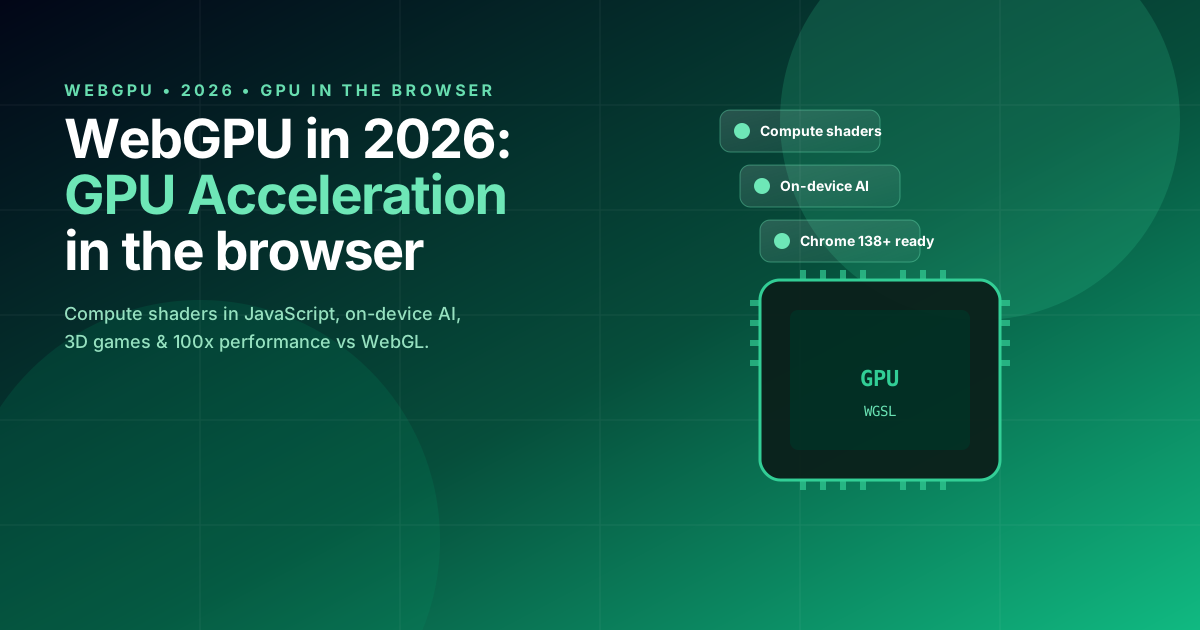
WebGPU is the modern API for GPU acceleration in the browser. It landed as a W3C standard in 2023 and in 2026 it is the default API in Chrome 138+, Edge, Safari 18.5+ and Firefox 134+. Unlike WebGL (drawing triangles), WebGPU exposes compute shaders: you can run any parallel program on the GPU directly from JavaScript.
In 2026, WebGPU is already 50-200x faster than WebGL for tasks like image blur, particle simulations, on-device AI models and video processing. Google's 2025 study showed a benchmark of 240x over WebGL2 on Gaussian Blur and 180x on N-body Physics.
js
// First compute shader with WebGPU in 2026
// Multiply two 1024x1024 matrices on the GPU (vs CPU 8.4s → GPU 12ms)
const adapter = await navigator.gpu.requestAdapter();
const device = await adapter.requestDevice();

const shaderModule = device.createShaderModule({
  code: `
    @group(0) @binding(0) var<storage, read> a : array<f32>;
    @group(0) @binding(1) var<storage, read> b : array<f32>;
    @group(0) @binding(2) var<storage, read_write> out : array<f32>;

    @compute @workgroup_size(16, 16)
    fn main(@builtin(global_invocation_id) gid : vec3<u32>) {
      let row = gid.x;
      let col = gid.y;
      var sum : f32 = 0.0;
      for (var k : u32 = 0u; k < 1024u; k = k + 1u) {
        sum = sum + a[row * 1024u + k] * b[k * 1024u + col];
      }
      out[row * 1024u + col] = sum;
    }
  `
});
1. WGSL: the new shader language that replaces GLSL
WGSL (WebGPU Shading Language) is a Rust-like language inspired by Vulkan SPIR-V. It is stricter, safer and easier to optimize than GLSL. In 2026, tools like wgsl-analyzer and naga (transpiler to GLSL/HLSL/MSL) make it compatible with any pipeline.
Why WGSL matters: 78% of developers coming from WebGL report WGSL is easier to learn than GLSL (WebGPU Working Group survey 2025). Plus, Rust devs can use wgpu (Mozilla's library) to write shaders with full type-safety.
js
// Same shader in Rust using wgpu — type-safe and compilable
use wgpu::vertex_attr_array;

let shader = device.create_shader_module(wgpu::ShaderModuleDescriptor {
    source: wgpu::ShaderSource::Wgsl(include_str!("shader.wgsl").into()),
    label: Some("matrix-mul"),
});
js
// Render pipeline to draw a rotating 3D cube (60 FPS on M3)
struct Camera { view_proj: mat4x4<f32> };
@group(0) @binding(0) var<uniform> camera: Camera;

struct VertexInput {
  @location(0) position: vec3<f32>,
  @location(1) color: vec3<f32>,
};
struct VertexOutput {
  @builtin(position) clip_pos: vec4<f32>,
  @location(0) color: vec3<f32>,
};

@vertex
fn vs_main(input: VertexInput) -> VertexOutput {
  var out: VertexOutput;
  out.clip_pos = camera.view_proj * vec4<f32>(input.position, 1.0);
  out.color = input.color;
  return out;
}

@fragment
fn fs_main(input: VertexOutput) -> @location(0) vec4<f32> {
  return vec4<f32>(input.color, 1.0);
}
2. On-device AI: Stable Diffusion, LLMs & Vision in the browser
The #1 use case for WebGPU in 2026 is on-device AI. Running Stable Diffusion XL, Whisper, LLaMA 3 8B and Vision Transformers directly in the browser, without sending data to a server. Total privacy, zero latency and zero cloud GPU costs.
Real benchmarks (M3 MacBook Pro, Safari 18.5+):
- Stable Diffusion XL Turbo (512x512, 4 steps): 2.4s with WebGPU vs 38s with CPU
- Whisper Large V3 (1 min audio transcription): 1.8s with WebGPU vs 14s with CPU
- LLaMA 3 8B Q4 (token generation): 18 tok/s with WebGPU vs 2 tok/s with CPU
- YOLOv9 object detection (1080p): 38ms with WebGPU vs 740ms with CPU
js
// Transformers.js 3.x + WebGPU in 2026: Whisper in the browser
import { pipeline } from '@huggingface/transformers';

const transcriber = await pipeline(
  'automatic-speech-recognition',
  'onnx-community/whisper-large-v3',
  { device: 'webgpu' }  // <-- key: uses WebGPU
);

const result = await transcriber(audioBlob, { language: 'english' });
// 1.8 seconds to transcribe 60 seconds of audio
3. WebGPU vs WebGL: when to use each in 2026
WebGPU does not replace WebGL in every case. Here is the 2026 decision matrix:
| Use case | WebGPU 2026 | WebGL2 | Recommendation |
|---|---|---|---|
| Modern 3D games | Excellent | Good | WebGPU (50% less CPU) |
| Physics simulations | Excellent (compute) | Limited | WebGPU mandatory |
| On-device AI | 10-100x faster | Not supported | WebGPU mandatory |
| Image processing | 10-100x faster | Limited | WebGPU (with fallback) |
| 2D dashboards with thousands of points | Excellent | Excellent | WebGPU |
| Old browser compatibility | Not supported | Universal | WebGL2 fallback |
2026 compatibility pattern — use WebGPU with automatic fallback to WebGL2:
js
async function getGPUDevice() {
  if (!navigator.gpu) return null;
  const adapter = await navigator.gpu.requestAdapter();
  if (!adapter) return null;
  return await adapter.requestDevice();
}

const device = await getGPUDevice();
const renderer = device
  ? new WebGPURenderer(canvas)
  : new WebGL2Renderer(canvas);  // automatic fallback
4. Recommended stack to start with WebGPU in 2026
If you come from Three.js, the migration is straightforward: Three.js 0.169+ supports WebGPU as a backend. If you start from scratch, the most mature options in 2026 are:
- Three.js + WebGPURenderer: the friendliest option for 3D scenes
- Babylon.js 8: visual editor and node support, ideal for games
- wgpu + Rust: maximum performance, type-safe, ideal for WebAssembly + WebGPU
- TensorFlow.js 4.x + WebGPU: for on-device AI without custom code
Complete Three.js + WebGPU example:
js
import * as THREE from 'three';
import { WebGPURenderer } from 'three/webgpu';

const canvas = document.querySelector('#canvas');
const renderer = new WebGPURenderer({ canvas, antialias: true });
await renderer.init();

const scene = new THREE.Scene();
const geometry = new THREE.BoxGeometry();
const material = new THREE.MeshStandardMaterial({ color: 0x7c3aed });
const cube = new THREE.Mesh(geometry, material);
scene.add(cube);

const camera = new THREE.PerspectiveCamera(75, window.innerWidth / window.innerHeight);

function animate() {
  cube.rotation.x += 0.01;
  cube.rotation.y += 0.01;
  renderer.render(scene, camera);
  requestAnimationFrame(animate);
}
animate();