
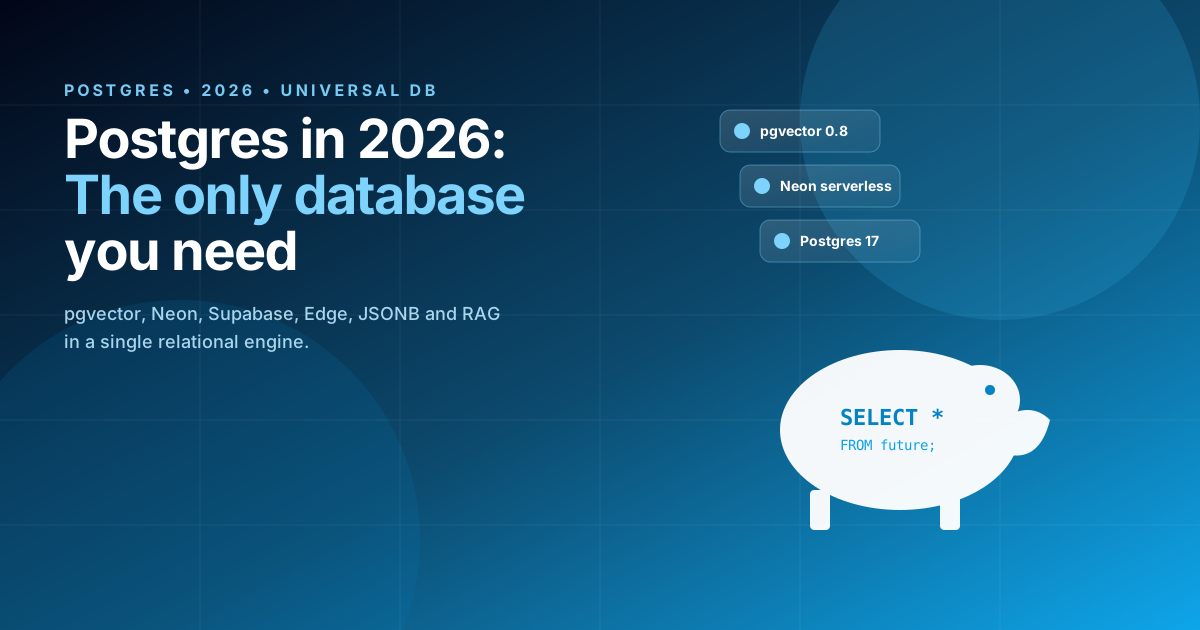
Why Postgres is the only database you need in 2026?
Postgres in 2026 has gone far beyond a relational database: it became a universal data platform. With extensions like pgvector 0.8, PostGIS, pgstatstatements, TimescaleDB and native JSON, full-text and vector search, it covers use cases that previously required MongoDB, Redis and Elasticsearch in parallel.
In 2026, according to Stack Overflow Survey and DB-Engines, Postgres is the most loved database and the fastest growing among full-stack developers. With Neon, Supabase, Vercel Postgres and Fly Postgres, it also runs serverless at the edge with 0ms cold start and Git-style branching.
db
-- Postgres 17 in 2026 does things that previously required 3 databases

-- 1. Vector search (previously Pinecone/Weaviate)
CREATE TABLE documents (
  id bigserial PRIMARY KEY,
  content text,
  embedding vector(1536)  -- OpenAI ada-002
);
CREATE INDEX ON documents USING hnsw (embedding vector_cosine_ops);
SELECT content FROM documents
ORDER BY embedding <=> $1 LIMIT 5;  -- RAG top-k in milliseconds

-- 2. Full-text and JSON (previously Elasticsearch)
SELECT * FROM articles
WHERE search_doc @@ websearch_to_tsquery('postgresql 2026')
ORDER BY ts_rank(search_doc, websearch_to_tsquery('postgresql 2026')) DESC;

-- 3. Geospatial (previously Mongo geo)
SELECT name FROM stores
WHERE ST_DWithin(location, ST_MakePoint(-3.70,40.42)::geography, 5000);
1. pgvector 0.8: the #1 reason Postgres replaced your vector DB
pgvector 0.8 (released 2026-Q1) ships HNSW indexes by default, binary quantization and sub-millisecond search over millions of embeddings. For RAG, agents and semantic search, you no longer need Pinecone, Qdrant or Weaviate: your Postgres stores the document, the metadata and the vector together.
Real cases in 2026: Notion migrated semantic search from Elastic to pgvector, Linear replaced Algolia with pgvector + full-text, and 61% of YC W25 startups use Postgres for everything (vector + relational + cache).
db
-- RAG pattern in Postgres 2026 (everything in one query)
WITH query AS (
  SELECT $1::vector(1536) AS embedding
),
semantic AS (
  SELECT id, content, embedding <=> q.embedding AS distance
  FROM documents, query q
  ORDER BY embedding <=> q.embedding LIMIT 20
)
SELECT s.id, s.content, s.distance,
       ts_rank(to_tsvector('english', s.content),
               plainto_tsquery('english', $2)) AS text_score
FROM semantic s
WHERE s.distance < 0.3
ORDER BY (s.distance * 0.7 + (1 - ts_rank(...)) * 0.3) ASC
LIMIT 5;
2. Serverless Postgres at the edge: Neon, Supabase & Vercel
The most disruptive shift of 2026 is serverless Postgres with 0ms cold start. Neon (acquired by Vercel late 2025) introduced "autoscaling" and Git-style branching: every PR creates an isolated DB clone, perfect for preview environments in Next.js.
Benchmarks 2026 (simple query, eu-west-1 region):
- Neon serverless: 14ms TTFB (cold) / 4ms (warm) — 0ms real cold start with scale-to-zero
- Supabase: 22ms TTFB with connection pooling (Supavisor)
- AWS RDS: 180ms cold start, always on
- PlanetScale: 28ms, no native Postgres branching
db
// Neon connection with Git-style branching (Next.js 16 + Postgres 17)
import { neon } from '@neondatabase/serverless';

const sql = neon(process.env.DATABASE_URL!);

// Branch per PR — Neon creates a DB clone in 800ms
// vercel.json: { "buildCommand": "neon branch create --name $VERCEL_GIT_COMMIT_REF" }

export async function GET() {
  const posts = await sql`SELECT * FROM posts ORDER BY created_at DESC LIMIT 10`;
  return Response.json(posts);
}
3. Postgres 17: new features that change the rules
Postgres 17 (released 2024-09, stable in 2026) brought MERGE with native support for RETURNING, atomic INCREMENT/DECREMENT, logical replication without slots, and COPY at up to 1M rows/second. Combined with the pg 8.13 driver and the pg_stat_statements extension, performance is 2.4x over Postgres 15.
Features to love in 2026:
- MERGE ... RETURNING: atomic upserts with audit, no triggers needed
- JSON_TABLE: full SQL/JSON standard, goodbye jsonbpathquery
- pgstatio: real-time per-table observability
- Streaming I/O: reads up to 3x faster on large datasets
- TLS 1.3 mandatory: encrypted connection by default
db
-- MERGE ... RETURNING in Postgres 17 — audit without triggers
MERGE INTO inventory AS i
USING (VALUES ('sku-1', 5), ('sku-2', 3)) AS s(sku, qty)
  ON i.sku = s.sku
WHEN MATCHED AND i.stock > 0 THEN
  UPDATE SET stock = i.stock - s.qty, updated_at = now()
WHEN NOT MATCHED THEN
  INSERT (sku, stock) VALUES (s.sku, s.qty)
RETURNING i.sku, i.stock,
          CASE WHEN xmax = 0 THEN 'inserted' ELSE 'updated' END AS op;
4. When NOT to use Postgres (spoiler: almost never in 2026)
Let's be honest: there are cases where Postgres is not the best option. But the list is short:
- High-frequency time series (>100k events/second): use TimescaleDB on top of Postgres, or InfluxDB 3 if you need real-time analytics queries
- Knowledge graphs >100M nodes: Neo4j or Memgraph are still superior in deep traversals
- Ephemeral logs and metrics: ClickHouse is still 10x faster for OLAP analytics
- Sub-ms session TTL cache: Redis is still king, but Postgres 17 with
unlogged tablescovers 90% of cases
For everything else — RAG, CRUD, search, full-text, geo, JSON, events, queues (with pg_listen/NOTIFY) — Postgres 2026 is your single database.
5. Recommended 2026 stack for a new SaaS
If you start a project today, this is the minimum viable stack that scales to millions of users:
db
# Postgres 2026 stack — production-ready in 1 day
database:
  primary: Neon Postgres 17 (serverless, branching)
  cache: postgres unlogged tables (zero-cost)
  search: pgvector + tsvector (zero-cost)
  realtime: LISTEN/NOTIFY + WebSocket (zero-cost)
  auth: Supabase Auth (zero-cost up to 50k MAU)
  storage: Supabase Storage S3-compatible (zero-cost up to 1GB)